
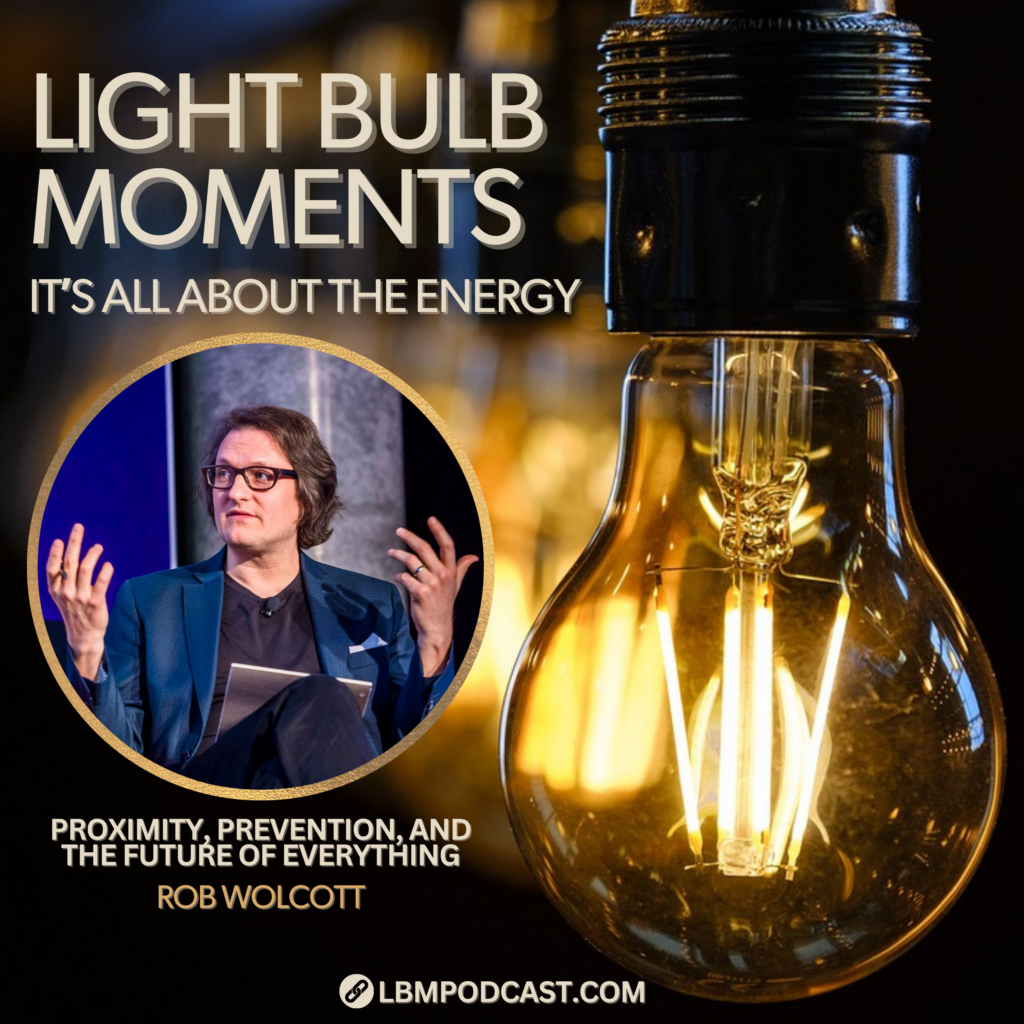
What if the future of business, healthcare, and even space travel could be predicted by a single idea-proximity? In this episode, you’ll hear how digital technologies are collapsing distance, reshaping supply chains, and moving healthcare from crisis response to true prevention.
Why This Episode Matters
This episode is for entrepreneurs, leaders, innovators, and anyone trying to understand where a rapidly changing world is heading. Proximity challenges us to rethink assumptions about demand, infrastructure, supply chains, convenience, and even how innovation happens. But perhaps its most important lesson is human: no matter how advanced technology becomes, trusted relationships remain essential. Build your network before you need it, invest in relationship capital over a lifetime, put yourself in rooms where unexpected things can happen, and never leave serendipity entirely to chance.
In this Episode, Philip and Rob Wolcott Discuss:
- Origin story of proximity and general-purpose technologies
- How digital changes production, supply chains, and “P = 0”
- Electric vehicles, charging infrastructure, and flawed paradigms
- Proximity’s impact on healthcare and preventive medicine
- Edge scaling, micro-factories, and rebuilding manufacturing
- Twin (The World Innovation Network) and relationship capital
- Venture investing through a proximity lens (water, pharma, food, space)
Conversation Takeaways
- Digital technologies fundamentally differ from industrial-age tools because they allow capabilities to be compressed into smaller packages and pushed closer to the exact moment and location of demand.
- Many massive infrastructure bets-like widespread public EV chargers-reflect old paradigms, and are likely to underperform because they ignore how proximity changes behavior and economics.
- Proximity in healthcare will increasingly compel the system away from late-stage diagnosis and toward continuous monitoring and prevention, dramatically improving outcomes and costs.
- Manufacturing’s future lies in “edge scaling”: smaller, distributed, digitally enabled micro-factories located near demand, not single gigantic plants half a world away.
- A diverse portfolio of trusted, ethically grounded relationships is becoming one of the most critical forms of capital for navigating disruption and building the future.
“A Portfolio of Trusted Relationships is Not Only Important; It’s Becoming Essential.” – Rob Wolcott
Rob Wolcott is an Adjunct Professor of Innovation at Booth, University of Chicago, and Kellogg, Northwestern University. From 2007 to 2019, he was a Clinical Professor of Innovation and Entrepreneurship at Kellogg, as well as a four-time Teacher of the Year in Kellogg’s EMBA program and a Visiting Fellow at Imperial College London. He is a venture investor in nearly 50 companies and venture funds, the Founder & Chair of TWIN Global (www.twinglobal.org), a global community of innovation leaders, and a board member at Abroad.io and global non-profit CureBlindness Project. He is the author of PROXIMITY (Columbia University Press, 2024), shortlisted for the Thinkers50 Breakthrough Idea of 2025 award, and a Contributor for Forbes on the impact of technology on business and humanity, with his work appearing in MIT Sloan Management Review, Harvard Business Review, The Wall Street Journal, and many other publications worldwide. He holds a BA in History and a Ph.D. in Industrial Engineering from Northwestern University.
Light Bulb Moments – Episode 228
Proximity, Prevention, and the Future of Everything with Rob Wolcott
The Light Bulb Moment of This Episode
The future may be less about predicting what people will want and more about recognizing demand that already exists-and moving the ability to fulfill that demand closer to the moment it’s needed. That’s the power of proximity. But as technology makes everything faster, easier, and more immediate, there’s an important human counterbalance: relationships. In a world increasingly driven by data, AI, speed, and instant gratification, intentionally building a portfolio of trusted relationships may become more valuable, not less. The future isn’t simply about bringing things closer to us. It’s about making sure we don’t allow the things that matter most to drift farther away.
Light Bulb Moments & Reflections from the Episode
1. Why predict demand when the demand is already there?
Businesses spend enormous energy trying to predict the future. Proximity changes the question: if you can understand demand that already exists and respond closer to where and when it occurs, you may not need to predict nearly as much.
2. Proximity is a differentiator.
Moving production, services, information, and solutions closer to the point of demand can change how we think about speed, efficiency, and opportunity. Where something happens can become just as important as what happens.
3. Making life easier isn’t always the same as making life better.
We increasingly expect immediate gratification-same-day delivery, instant information, immediate access. Proximity makes that possible, but it also raises a bigger question: just because we can eliminate friction from our lives, should we eliminate all of it?
4. Don’t wait for the infrastructure to arrive.
Innovation doesn’t always require the traditional infrastructure to be built first. New models can allow us to move toward an opportunity while the surrounding systems are still catching up.
5. What if supply-chain risk isn’t always a supply-chain problem?
When production and solutions can move closer to demand, some of the assumptions behind traditional supply chains begin to change. Instead of only figuring out how to protect a long chain, ask whether the chain itself can be shortened.
6. Put smart people in a room and let them figure it out.
Sometimes creativity needs proximity too. Bring capable people together, close the door, give them a difficult problem, and let ideas collide. Solutions often emerge through interaction that wouldn’t happen independently.
7. Always ask to be involved.
Don’t wait to be invited into every opportunity. Raise your hand, show interest, and put yourself in environments where interesting things can happen. You never know where saying yes might take you.
8. When a mentor gives you advice, overdo it.
If you’ve intentionally chosen someone whose judgment you trust, take their advice seriously enough to act on it. Relationships with mentors become far more valuable when learning turns into action.
9. Build connections for a lifetime.
Don’t treat relationships as temporary transactions tied to today’s opportunity. Stay connected, be proactive, and continue investing long after the original reason for meeting someone has passed.
10. Learn and build through trusted relationships.
Knowledge doesn’t develop only through books, technology, or data. Some of our greatest learning happens through people we trust enough to exchange ideas with, challenge assumptions with, and build alongside.
11. Never leave serendipity to chance.
Serendipity sounds accidental, but you can create conditions that make unexpected opportunities more likely. Put yourself around interesting people, enter new rooms, build relationships, and remain open to what might happen.
12. Live the energy.
Everything we do affects the people around us. The energy we bring into conversations, relationships, and opportunities can influence what comes back to us and what becomes possible next.
13. Build a portfolio of trusted relationships.
Just as we intentionally build portfolios of financial assets, we should intentionally invest in relationship capital. Trusted relationships are not a nice-to-have-they are needed, essential, and critical.
14. As technology accelerates, relationship capital becomes more important.
AI and technology may make the world faster and more efficient, but they can also pull us away from genuine human connection. If the world is trending away from relationships, we have to consciously and intentionally bring them back.
Connect with Rob Wolcott:
Website: www.proximitybook.net, www.twinglobal.org
LinkedIn: https://www.linkedin.com/in/robert-c-wolcott-4a624a/
Connect with Philip:
Website: https://www.fornarolaw.com/
Podcast Website: https://lbmpodcast.com/
Pinterest: https://www.pinterest.com/philipfornaro/
YouTube: https://www.youtube.com/@fornarolaw3002
LinkedIn: https://www.linkedin.com/in/fornarolaw
Instagram: https://www.instagram.com/fornarolaw/
Facebook: https://www.facebook.com/FornaroLaw
https://www.facebook.com/philip.fornaro.3
Podcast Production by Turnkey Podcast. Thinking of starting a podcast? Get more info at https://turnkeypodcast.com/ or reach out to Doug Sandler directly at Doug@TurnkeyPodcast.com or call 410-340-6861.
You’re the expert. Your podcast will prove it.